
Artificial Intelligence CAPEX
$3.5 trillion in hyperscaler spending forecast
A Bloomberg Intelligence report forecasts that AI-related capital spending by hyperscalers will total $3.5 trillion over the next five years — more than triple the cumulative 2023–25 total. Annual AI CAPEX is projected to rise from roughly $240 billion in calendar year 2024 to approximately $1 trillion by 2030, with cloud service providers (CSPs) accounting for 60–80% of the total and sovereign AI programmes plus non-CSP enterprises filling the remainder. For equity investors screening technology and infrastructure names, the scale of this build-out is not a marginal tailwind; it is reshaping capex cycles across semiconductors, real estate, utilities, and industrial supply chains simultaneously.
The four dominant hyperscalers — Microsoft, Alphabet (Google), Amazon, and Meta — are the primary demand anchors. Microsoft has guided toward sustained double-digit growth in Azure infrastructure spend, driven by Copilot enterprise adoption and OpenAI partnership workloads. Alphabet is expanding custom TPU (Tensor Processing Unit) capacity while maintaining large Nvidia GPU clusters for Gemini training and inference. Amazon Web Services continues to invest in Trainium and Inferentia silicon alongside third-party accelerators, reflecting a dual strategy of margin protection and workload optimisation. Meta, historically the most aggressive on open-source model development, is simultaneously building multi-gigawatt training campuses to support Llama-family models and its advertising AI stack. Together, these four companies are expected to account for the majority of the nearly $539 billion in near-term AI CAPEX attributed to major CSPs, with Oracle, CoreWeave, and specialist neocloud providers adding incremental but fast-growing demand.
OpenAI Stargate and the Neocloud Layer
OpenAI's supply agreements with AMD, Nvidia, and Broadcom under the “Stargate” global programme are projected to amount to $500 billion, bringing OpenAI's total planned spending through the end of the decade to more than $1 trillion. OpenAI is expected to become the single largest non-hyperscaler source of AI-related CAPEX and to drive the creation of nearly 42 GW of data centre capacity — equivalent to the power demand of several mid-sized countries. Stargate represents a structural shift: model labs are no longer purely software renters but are becoming infrastructure principals, signing long-dated offtake agreements that backstop chip orders, power contracts, and construction financing. For screening purposes, this blurs the line between “AI software” and “AI infrastructure” beneficiaries and increases correlation among names previously considered diversifiers.
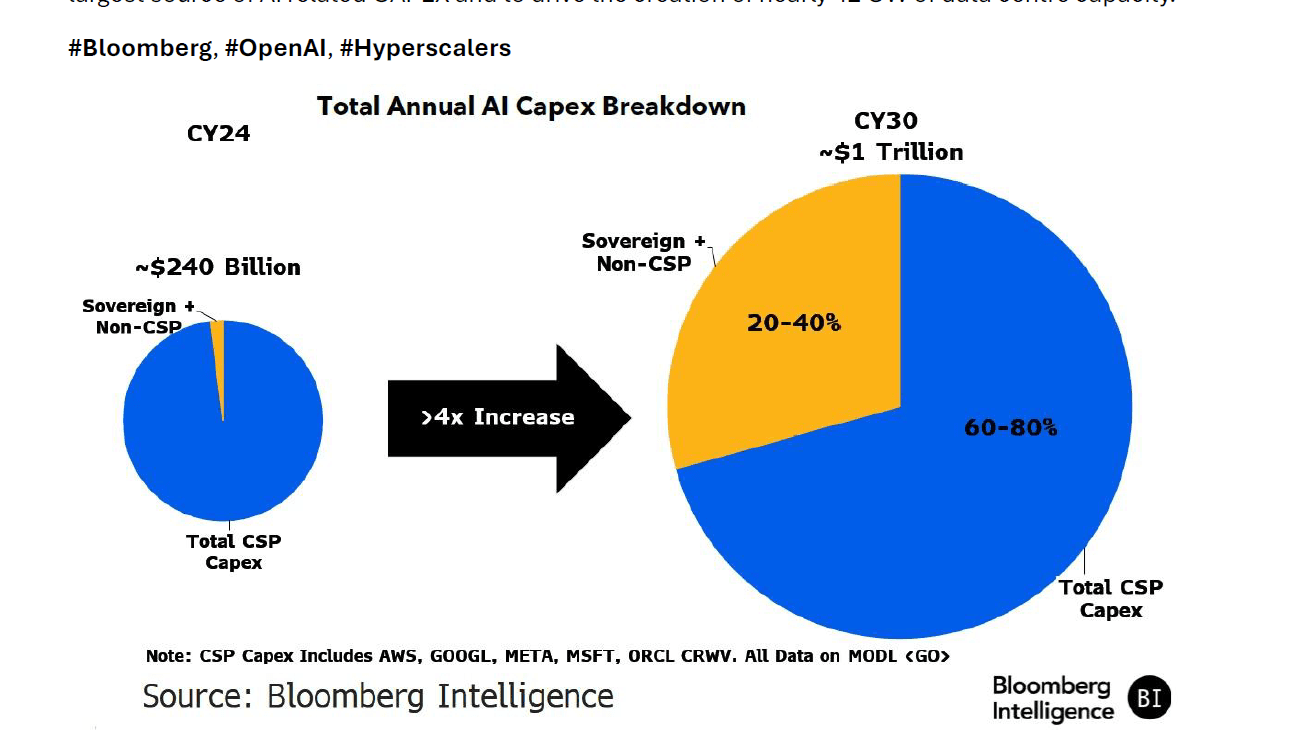
Total Annual AI Capex Breakdown - Source: Bloomberg Intelligence
Semiconductor Implications
The semiconductor complex remains the most direct beneficiary, but dispersion within the group is widening. Nvidia continues to dominate AI accelerator revenue, yet hyperscaler custom silicon programmes (Google TPU, Amazon Trainium/Inferentia, Microsoft Maia) pose a medium-term share risk that screening models should treat as a structural headwind to pure-play GPU multiples, not a near-term demand collapse. AMD is gaining share in both training and inference through MI300-series ramps and OpenAI Stargate allocations. Broadcom benefits from custom ASIC design wins and networking silicon (Tomahawk/Jericho switches) that scale with cluster size. Memory vendors — SK Hynix, Micron, Samsung — face a HBM (High Bandwidth Memory) supply bottleneck that supports pricing power through at least 2027, while traditional DRAM supply remains cyclical. Equipment names (ASML, Applied Materials, Lam Research) see elongated order books as leading-edge fab utilisation rises, though geopolitical export controls on advanced lithography to China introduce a bifurcated revenue stream that favours domestic champions in restricted markets.
Investors should monitor depreciation schedules and useful life assumptions on AI hardware. Hyperscalers are shortening GPU refresh cycles from four-to-five years toward three years or less as model architectures evolve rapidly. Faster obsolescence supports recurring chip demand but compresses return on invested capital (ROIC) unless monetisation — via cloud API pricing, advertising lift, or enterprise seat expansion — keeps pace. Our screening framework flags companies where revenue growth from AI CAPEX exceeds operating cash flow growth, as a potential signal of unsustainable investment intensity.
Data Center REITs and Physical Infrastructure
Data centre REITs and colocation operators — including Equinix, Digital Realty, and specialist developers — are experiencing a bifurcated market. Hyperscale build-to-suit campuses in power-rich regions (Virginia, Texas, Ohio, Nordic countries) command long lease terms with investment-grade tenants, supporting cap-rate compression and development pipeline visibility. Retail colocation, by contrast, faces rising power density requirements: a single AI rack can draw 30–100 kW versus 5–10 kW for traditional enterprise workloads, forcing costly electrical and cooling retrofits that may not be economic for legacy facilities. Screening for REIT exposure should distinguish between power-entitled land banks (high option value) and legacy urban assets (potential stranded risk).
Construction backlogs for mechanical, electrical, and plumbing (MEP) contractors, switchgear manufacturers, and liquid-cooling vendors extend 18–24 months in several US markets. Liquid cooling adoption — direct-to-chip and immersion — is transitioning from niche HPC deployments to mainstream AI clusters, creating a new sub-cycle within data centre infrastructure that favours early movers such as Vertiv and specialist cooling firms over generic HVAC suppliers.
Energy Demand and Grid Constraints
The 42 GW of capacity associated with OpenAI Stargate alone underscores a constraint that equity markets are only beginning to price: interconnect queue delays and baseload power availability. Data centres are increasingly signing behind-the-meter agreements with nuclear, gas, and renewable-plus-storage developers. Utilities with regulated rate bases in high-growth data centre markets (Dominion Energy in Virginia, American Electric Power in Ohio, Vistra in ERCOT) may see accelerated capital expenditure plans approved by regulators, supporting earnings visibility. Merchant power producers and natural gas pipeline operators benefit from baseload demand that renewables alone cannot yet satisfy at required uptime levels (99.99%+ for training clusters).
For ESG-conscious portfolios, the tension between AI CAPEX-driven emissions and corporate net-zero commitments is acute. Hyperscalers are contracting for 24/7 carbon-free energy matching, but near-term grid reality in the US Sun Belt and Midwest still relies heavily on gas peakers. Screening for energy exposure should weight contracted pipeline capacity and nuclear licence extensions alongside renewable build rates, as AI load growth is likely to extend the useful life of existing baseload assets.
Investment Screening Considerations
The $3.5 trillion forecast is not a guarantee of proportional equity returns. History suggests that large capex cycles enrich equipment suppliers early, infrastructure owners at mid-cycle, and application-layer monetisers only if pricing power materialises. Key metrics for Strategyland screens include: (1) AI CAPEX as a percentage of total capex for CSPs — rising above 50% signals binary dependence on AI ROI; (2) backlog-to-revenue ratios for semiconductor equipment and EPC firms — above 1.5x may indicate overheating; (3) power purchase agreement (PPA) coverage ratios for data centre developers — below 80% of projected load creates margin risk; and (4) free cash flow yield relative to AI-driven revenue growth — divergence warns of capital intensity outrunning cash generation. Sovereign AI programmes (UAE, Saudi Arabia, France, India) add a non-commercial demand layer that may sustain capex even if US hyperscaler growth moderates, but introduce geopolitical and currency risk for multinational suppliers.
#Bloomberg, #OpenAI, #Hyperscalers
Author: Strategyland Research Team