
WTI Crude Oil
Volatility surge and hedging cost implications
West Texas Intermediate (WTI) crude oil has entered a regime of elevated price volatility that extends well beyond the magnitude of spot price changes. Since late February 2026, the average daily absolute price move has surged to $8.226/bbl, compared with $2.098/bbl in the prior period since 1 January 2026 — roughly a fourfold increase. This shift matters for equity screening because oil volatility propagates through energy sector earnings, consumer inflation expectations, central bank reaction functions, and cross-asset correlations in ways that spot price levels alone do not capture. When implied volatility rises, hedging costs for producers, refiners, and airlines escalate, capital allocation toward discretionary sectors compresses, and equity risk premia in energy-adjacent markets widen.
The NYMEX Light Sweet Crude Oil (WTI) continuous futures contract remains the global benchmark for US domestic pricing and the reference for the CBOE Crude Oil ETF Volatility Index (OVX). The chart below illustrates the divergence between price action and volatility: WTI has traded in a wide but not historically extreme range, while OVX has spiked above 120 — a level associated with prior geopolitical shocks including the 2022 Russia–Ukraine invasion and the 2020 pandemic demand collapse.
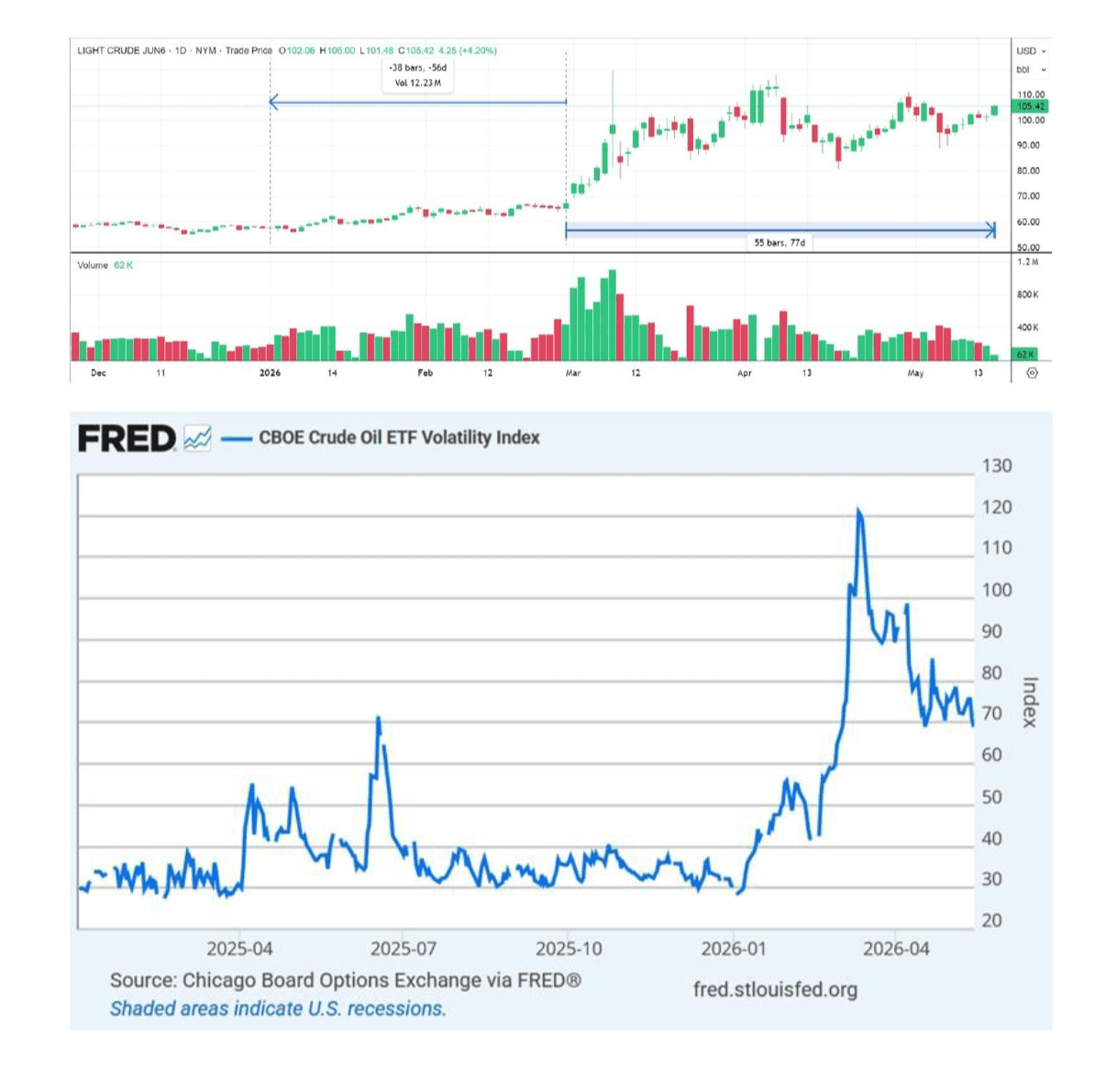
NYMEX WTI Futures & CBOE Crude Oil ETF Volatility Index - Source: FRED, Chicago Board Options Exchange
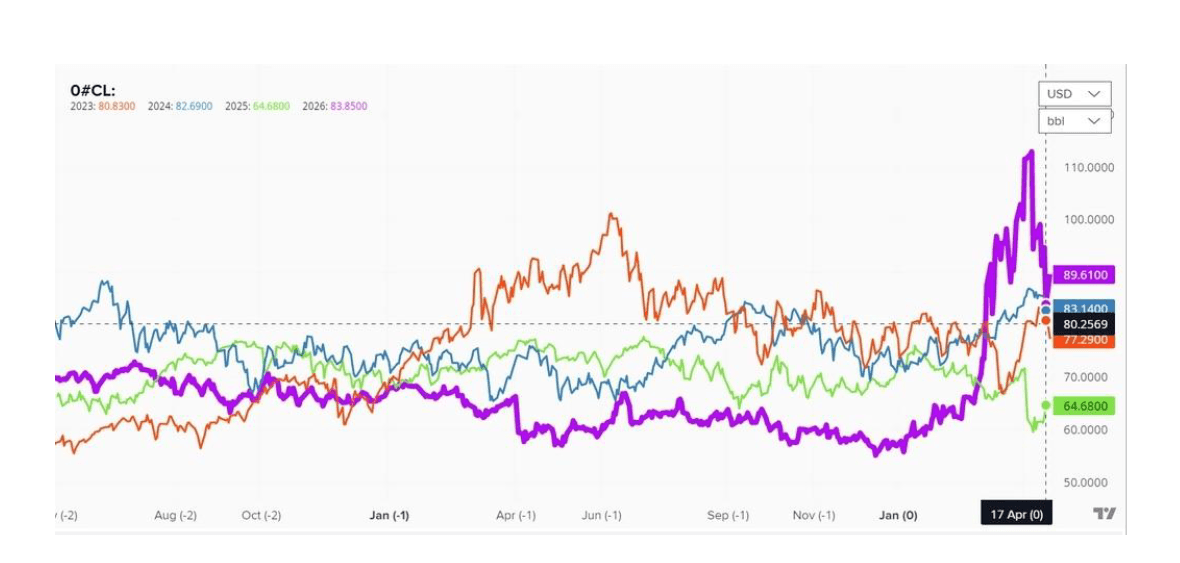
WTI Crude Oil Seasonality Chart (O#CL) - Multi-year overlay
OPEC+ Supply Management
OPEC+ production policy remains the primary supply-side anchor, but its effectiveness as a price stabiliser has diminished in the current environment. The alliance's voluntary production cuts of approximately 2.2 million barrels per day (mb/d), layered atop earlier reductions, have supported floor prices near $70/bbl WTI. However, compliance wavering among secondary producers, combined with quota disputes between Saudi Arabia and Kazakhstan over overproduction, has introduced policy uncertainty that options markets price as tail risk rather than base-case supply discipline. Saudi Arabia's willingness to absorb further market share loss to defend price floors is being tested by rising non-OPEC supply from US shale (Permian basin output remains above 6.2 mb/d), Guyana (ExxonMobil Stabroek block ramp), and Brazil (pre-salt deepwater).
The group's June 2026 ministerial meeting deferred a decision on unwinding 2.2 mb/d of voluntary cuts, maintaining the status quo but failing to resolve the market's central question: whether OPEC+ will prioritise market share recovery or price defence as global demand growth slows to an International Energy Agency (IEA) forecast of 0.9 mb/d for 2026. For screening UK-listed majors — BP and Shell — OPEC+ floor pricing supports upstream free cash flow but constrains refining margins when crude feedstock costs rise faster than product cracks. Integrated models benefit from downstream hedging; pure upstream names face higher earnings volatility.
Geopolitical Risk Premium
Geopolitical factors are contributing a persistent risk premium estimated at $8–12/bbl above fundamental supply-demand balance models. Red Sea shipping disruptions, though reduced from 2024 peaks, continue to add $0.50–1.00/bbl to freight-insurance-adjusted delivered costs for European and Asian refiners. US sanctions enforcement on Iranian and Russian crude exports has tightened medium-sour crude availability, widening the WTI–Brent spread and the Dubai–WTI spread in ways that favour US Gulf Coast exporters but penalise European import-dependent refiners. Middle East escalation scenarios — particularly around Strait of Hormuz transit, which handles approximately 20% of global seaborne oil — are priced in OVX rather than spot, explaining the volatility–price decoupling visible in the charts above.
US Strategic Petroleum Reserve (SPR) policy adds a secondary geopolitical lever. The Department of Energy's slower-than-expected SPR replenishment pace (targeting $79/bbl WTI purchase bands) removes a traditional volatility dampener, leaving the market more exposed to sudden supply shocks without a visible government backstop.
Hedging Costs and Market Microstructure
A fourfold increase in average daily price moves surges hedging costs manyfold, since both call and put option values rise with higher implied volatility. Refiners and airlines — including International Consolidated Airlines Group (IAG) and easyJet in the FTSE 100 — pay materially more for protection and are shifting toward collars, costless put spreads, and reduced hedge ratios to manage premium outlays. According to FRED data from the Federal Reserve Bank of St. Louis, 30-day implied volatility for crude oil has remained elevated for nearly three months, making hedging expensive even when spot prices lack directional conviction. Market makers widen bid-ask spreads to compensate for gap risk in overnight sessions, reducing liquidity in short-dated options and front-month futures straddles — a microstructure shift that amplifies move sizes on low-volume days.
The seasonality chart confirms that 2026 implied volatility is running well above the 2023–2025 multi-year overlay for equivalent calendar months, suggesting the current regime is structural rather than seasonal. Historically, Q2–Q3 driving season demand supports prices but does not typically sustain OVX above 80 unless accompanied by a supply disruption event.
UK Energy Stocks and Sector Exposure
For UK equity investors, oil volatility transmits through several channels with differing magnitudes. BP and Shell — together representing over 20% of the FTSE 100's energy weight — benefit from higher realised crude prices on upstream segments but face margin compression in refining and chemicals when volatility disrupts crack spread predictability. Both majors maintain active hedging programmes; elevated OVX increases the cost of rolling hedges forward, potentially reducing reported hedge gains in subsequent quarters. Harbour Energy, the largest UK-listed independent producer, has greater unhedged exposure and therefore higher earnings sensitivity to WTI moves — our screening flags Harbour as a high-beta play on oil volatility normalisation.
Midstream and services names — John Wood Group, Petrofac (where listed exposure remains) — face countervailing forces: higher oil prices support capex budgets from national oil companies, but project delays and cost inflation in offshore wind and oilfield services compress margins. UK utilities with gas-linked generation — Centrica, Drax — see partial offset from higher wholesale power prices when gas-oil substitution economics shift, though regulatory caps on consumer tariffs limit pass-through speed.
Equity Market Correlation
WTI volatility correlates with broader equity market performance through inflation expectations, sector rotation, and risk-off flows. Since February 2026, the 30-day rolling correlation between daily WTI returns and FTSE 100 returns has turned positive (+0.35 to +0.45 range), a shift from the mildly negative correlation that prevailed during 2024–25 when tech-led growth dominated index returns. When oil volatility rises without commensurate economic growth — a “stagflationary volatility” pattern — equity multiples compress, particularly in rate-sensitive sectors (real estate, utilities, consumer discretionary). The S&P 500 Energy sector has outperformed the broader index by 8–12% year-to-date in 2026, but this outperformance is concentrated in upstream E&P names; energy equipment and services lag due to capex uncertainty.
Cross-asset screening metrics we monitor include: (1) OVX–VIX spread — widening above 20 points signals energy-specific stress decoupled from general equity fear; (2) WTI 3-month futures curve slope — backwardation steeper than $3/bbl supports near-term supply tightness narratives; (3) energy sector weight in FTSE 100 relative to 5-year average — mean-reversion trades become viable above +1.5 standard deviations; and (4) breakeven inflation rate (5y5y) sensitivity to OVX changes — rising breakevens alongside rising OVX historically precedes central bank hawkish repricing that pressures growth equities. Until implied volatility normalises below 60, we maintain a defensive tilt in UK consumer and transport screens and an overweight bias in upstream energy with active hedge cost monitoring.
Sources
Author: Strategyland Research Team